
Co-production and counter-spaces in the neoliberal city
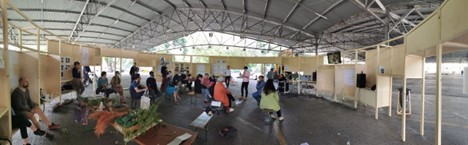
Image 1: Co-production of the masterplan for a park, workshop on site, June 2021, Pointe de la Jonction, Geneva, Switzerland. Winning tender with LB Architects for Geneva City Council. Photo: Louise Koch.
Marie Berthet Meylan, Research Fellow, Sustainability Research Institute
Before becoming a co-production researcher, I worked as a consultant for participatory urban development projects. The practice of urban co-production preceded my academic knowledge of it.
Although co-production is not new, in academia like in the civic and third sectors, it has, in recent years, attracted increasing attention in a vast spectrum of academic disciplines, for its potential to tackle structural injustices in the research process, in the delivery of solutions, and in society in general. In fact, the popularity of co-production makes difficult to distinguish it from other bottom-up research methods.
In this post, I therefore question what (urban) co-production is beyond the act of ‘doing things together’. But rather than trying to define it, I suggest we consider the context in which co-production operates, as well as the kind of spaces it produces.
Epistemology: co-production and neoliberalism
Historically, co-production was first coined by Elinor Ostrom in the early 1970s (who later went on to receive no less than a Nobel Prize in Economic Sciences). At the time, she was researching the self-organised delivery of public services by citizen-led organisations in the US (Ostrom 1972, 1996), in a context of state rollback. In this environment, co-production described the partial or total delivery of public services by citizens (Nabatchi et al. 2017), initiatives which emerged to remedy the dismantling of public services. We can now look back at this context as the very early stage of neoliberalism in the US.
Although co-production has long crossed the boundaries of service design and delivery, it is worth noting that, in the academic world, the most widespread and established field of co-production-led research to this day is medical research. This shows that co-production is still deeply tied up with ‘service design’.
Over time, co-production-led methods have been largely embraced by the corporate world as they allow private companies to design and marketise products, which are closer to consumers’ interests. This process of corporate appropriation led to theoretical distinctions between the various stages of co-production (co-design, co-creation, co-production, etc), drawing a line between the radical, socially grounded practice of co-production and its appropriation by the market (Lee et al., 2024). This line of argument highlights an important aspect of co-production: its anchorage in the neoliberal context as a direct response to neoliberal policies.
Using co-production in urban development projects: two case studies in Geneva (Switzerland) and Leeds (UK)

Image 2: Test to grow a tree nursery in the self-managed garden, September 2024, Pointe de la Jonction, Geneva, Switzerland. Image: Marie Berthet.
To discuss the relationship between co-production and neoliberalism, I would like to bring in two case studies. The first one is a project in which I have been involved since 2009 as part of the team of consultants commissioned by the Geneva City Council (Switzerland). This community-led project aims at transforming la Pointe de la Jonction, the site of a former bus depot, into a public green space. This project is the result of 10 years of grassroots organisation to reclaim the site as a park. My main role in this project involved organising public meetings and workshops to work towards the delivery of a master plan (Image 1).

Image 3: map of Alwoodley with possible community-led interventions for nature recovery, 2024. Design and community land mapping consulting: Mikey Tomkins, in collaboration with Hyde Park Source, Wildlife Friendly Otley and Leeds City Council.
The second example is a project funded through the University of Leeds’ policy support fund, for which I worked together with UoL colleagues, our community partner Hyde Park Source, as well as Leeds City Council Asset Management team. This project aimed at facilitating access to public land for community action in Leeds.
Three aspects of these projects are relevant to this conversation.
The first one is that both have in common to bring together a tripartite coalition of actors including the civic sector, representatives of a public body (in this instance Geneva and Leeds City Councils) and academics, a composition of actors which aligns with Olstrom’s initial description of co-production. In addition, these actors have come together to protect or fight back against the loss of public assets and services.
Subsequently, the second aspect is obviously the neoliberal context in which these projects take place and respond to.
Geneva has a long-standing history of urban co-production, a legacy, which materialised in a variety of self-managed and community-led spaces, most of which were evicted between 2002 and 2006 (Radio Télévision Suisse, 2008). In 2015, Geneva was thought to be “the second most expensive city in the world” (ats/Newsnet, 2015), with unprecedented levels of transnational investment in real estate in the city since the 2008 financial crash. This increasingly neoliberalised urban environment contributed to a feeling of urban dispossession amongst local communities. The Council adopted the co-production approach partly because of the mounting pressure from local residents. Combining this intention with the traditional top-down approach of planning, however, is challenging. Beyond the design aspect, our role as consultants largely involved creating opportunities to transform the relationship between the Council and the civic sector into a partnership.
In Leeds, in the past two decades, the Council has introduced policies to increase community-Council collaboration, amongst which Community Asset Transfer, and the Team Leeds approach, to work more closely with local communities. Between 2009 and 2024, however, the Council has lost 70% of its budget (Leeds City Council. 2024), a context of acute austerity, which forced the municipality to reduce services, sell off assets, and hinders its capacity to develop public-civic collaborations.
The project in Leeds stemmed from community groups who wanted to develop nature-based projects (community gardening, nature recovery, urban food growing) and were seeking access to public land. These projects transpired with the desire of communities to come together to improve their neighbourhood, although they also carried an underlying sense of what Chettri and Venhovens have coined as ‘infrastructural anxiety’ (2024), a sentiment triggered by the decline of positive, transformative state action. The co-production process was centered on a collective journey to design suitable solutions for community-public sector actions, or, in Albrechts’ words (2012), a “radical type of strategic planning” that “combines the provision of public goods/services needed with the building of a strong, resilient and mutually supportive community that could assure its members their needs would be met.” (p.47).
Finally, the third and perhaps most obvious aspect that I would like to bring up is that the two projects are driven by the urge to create community spaces by means of- and for community action in a neoliberal environment which threatens such spaces. In Geneva, local communities are fighting back to maintain spaces over which they have agency and governance. In Leeds, community groups and the third sector are responding to food poverty and the decline of biodiversity. It is important to highlight that, in both instances, co-production has allowed us to imagine, design and create spaces that would otherwise not exist in the neoliberal city.
Co-production is transformative
The definition of urban co-production still predominantly draws from initiatives in which citizens make up for the decline or absence of State services and reclaim governance over assets and services (Bulkeley et al., 2016). Urban co-production can be described as a transformative process, that has the potential to reshape public services by incorporating a much broader range of citizen-state partnerships. As Brandsen and Honingh coin it, co-production "is regarded as a possible solution to the public sector's decreased legitimacy and dwindling resources by accessing more of society's resources." (2015, p.427). As a co-production practitioner, I aim to create opportunities for civil servants and civil society members to challenge the terms in which these institutions interact.
Nabatchi et al. (2017), also discuss the ambivalent attitude of the State in relation to neoliberalism, highlighting that the "consumers' choice" narrative in the neoliberal transformation of public services, is often rebranded as co-production to legitimate the transfer of state responsibility onto citizens. In the neoliberal context, it is crucial to re-frame urban co-production as a process that tackles urban and social injustice, not just as magic recipe for collaborative design.
Co-production is uncomfortable
Albrechts (2012) claims that co-production “implies changing the perceptions and the approach of many professionals (public and private) about how plans, policies and public services are conceived and delivered, with the objective of enabling the (structural) change needed in an open and equitable way.” As an actor, the shift is often uncomfortable. The neoliberal discourse is very much engrained in the way that local authorities manage their assets and services with profitability and efficiency prioritised over values such as community growth or social value. Both urban co-production processes described above allowed participants to imagine and create urban spaces, which offer alternatives to the neoliberal urban regime in which they exist.
Bibliography
Albrechts, L. 2012. Reframing strategic spatial planning by using a coproduction perspective. Planning Theory. Vol.12(1), pp.46–63.
ats/Newsnet, 2015. Zurich et Genève désormais villes les plus chères du monde. La Tribune de Genève. [Online]. 3 March. [Accessed 10 November 2020]. Available from:
https://www.tdg.ch/economie/zurichgeneve-desormais-villes-cheres-monde/story/12745653
Brandsen, T. and Honingh, M. 2015. Distinguishing Different Types of Coproduction: A Conceptual Analysis Based on the Classical Definitions. Public Administration Review. Vol.76(3), pp.427-435.
Bulkeley,H., Coenen, L., Frantzeskaki, N., Hartmann, C., Kronsell, A., Mai, L., Marvin, S., McCormick, K., Steenbergen, F. and Voytenko Palgan, Y. 2016. Urban living labs: governing urban sustainability transitions. Current Opinion in Environmental Sustainability. 22, pp.13-17.
Lee, D., Feiertag, P. and Unger, L. 2024. Co-production, co-creation or co-design of public space? A systematic review. Cities. No.154, pp.1-13.
Leeds City Council. 2024. Leeds City Council Deputy Leader sets out the scale of financial challenges facing the council and local authority sector. [Online]. 18 September. [Accessed 6 February 2025]. Available from:
Nabatchi, T., Sancino, A. and Sicilia, M. 2017. Varieties of Participation in Public Services: the Who, When, and What of Coproduction. Public Administration Review. 77(5), pp.766-776.
Ostrom, E., 1972. Metropolitan reform: propositions derived from two traditions. Social Science Quarterly. 53(3), pp.474-493.
Ostrom, E., 1996. Crossing the Great Divide: Coproduction, Synergy and Development. World Development. 24(6), pp.1073-1087.
Radio Television Suisse. 2008. Squats genevois: non à la méthode Zappelli. [Online]. 28 July. [Accessed 29 September 2020]. Available from:
https://www.letemps.ch/suisse/daniel-zappelli-se-resout-demissionner
Venhovens, M. and Chettri, M. 2024. Foreword. In: Venhovens, M. and Chettri, M. eds. Roadsides Collection. [Online]. No.12, pp.1-7. [Accessed 6 February 2025]. Available from:
https://roadsides.net/chettri-venhovens-012/
If you would like any further information, please email Marie Berthet Meylan [email protected].
If you are a member of staff at the University of Leeds and would like to write a blog on your experiences of co-production, please contact [email protected] to discuss your idea. Please join the Co-production Network, which is hosted on the Engaged Research MS Team (University of Leeds staff only).